
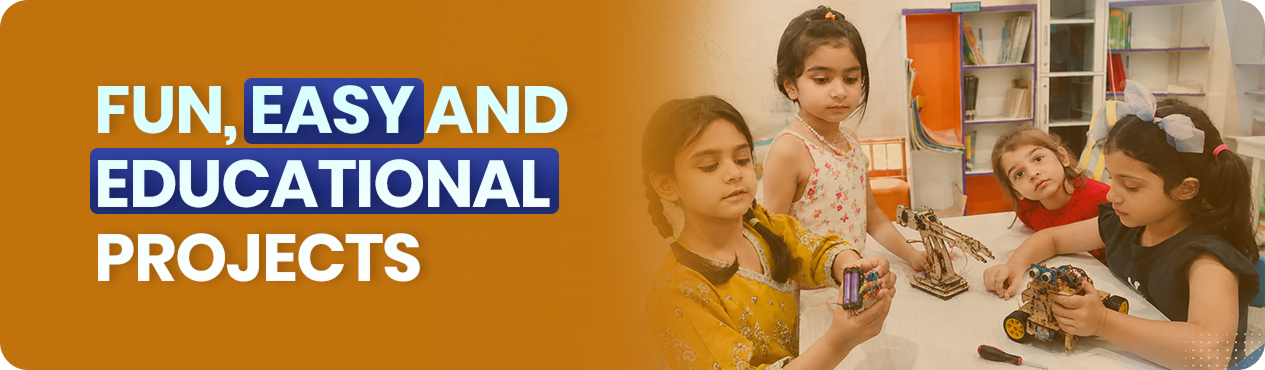

STEM Activities for Kids: Fun, Easy and Educational Projects
Students learn through inquiry, discovery, and understanding. This can be achieved through STEM activities by combining creative projects with science, technology, engineering and mathematics.
By engaging in STEM activities such as building a paper bridge, creating a simple circuit, or designing a computer game, children can learn through trial and error and problem solving.
What Is STEAM Education?
STEAM education refers to the integration of Science, Technology, Engineering, Arts, and Mathematics with problem-solving and solutions. Incorporation of Arts into STEAM education enhances creativity, design, communication, and other problem-solving skills.
For example, when designing a bridge, mathematics will be used for measurements, engineering for designing the bridge, science for understanding the forces that act on the bridge, technology for researching and testing, and arts for designing the bridge.
Why Are STEM Activities Important for Kids?
STEM Activities are not limited to Science and Mathematics alone; rather, it involves planning projects that help develop critical skills like practical thinking, experimentation, teamwork, and problem-solving.
Develop Critical Thinking Skills: Identify the issue, think about different methods, try the best method, and if it doesn’t work, then adopt a different one.
Encourages Creativity: The creation of structures, the invention of gadgets, and coding games will allow the child to come up with creative solutions.
Develops Teamwork: There are many activities that require teamwork. The child learns how to share his/her ideas, listen to others, share responsibilities, and work together towards a common goal.
Helps Practical Learning: Practical learning helps students understand abstract theories. Through activities such as building, testing, and modifying something, children will learn the application of concepts learned in class to real-life situations.
10+ Fun STEM Activities for Kids
- Build a Paper Bridge: Construct a bridge from paper that can carry weight through exploration of structures and engineering.
- Make a Volcano: Conduct experiments with baking soda and vinegar to understand cause-and-effect relationships.
- Build a Balloon-Powered Car: Design and build a car that would be powered by a balloon through exploration of forces and engineering.
- Build a Straw Tower: Construct a tower using straws to understand the principles of balance and structures.
- Basic Filtration Device: Build a simple water filtration device using materials such as sand and cotton.
- Build Your Own Catapult: Design your own catapult to learn fundamentals of force, distance, angle, and physics.
- Build a Simple Electric Circuit: Construct a circuit that is controlled by a switch and an LED light bulb.
- Design Your Own LEGO Maze: Design a LEGO maze to develop skills in logical reasoning and problem solving.
- Design a Simple Game: Design and code a simple game to understand fundamental principles of sequence, commands, and conditions.
- Build a Simple Robot: Build a simple robot to learn the basics of programming and sensors.
Easy STEM Activities for Kids at Home
Not all STEM activities require lab activities and are resource-intensive. STEM activities can be easily conducted with household items.
STEM Activities Using Household Items: They include activities that use paper, cardboard, plastic cups, straws, coins, bottles, tape, and other forms of recyclable packaging.
No-PREP STEM Activities: Some of these lessons do not require any form of preparation before implementation. Such as asking kids to make assumptions about floating abilities.
Indoor STEM Activities: Indoor activities may include construction, experiments, puzzles, coding, measuring, and construction activities. Indoor activities are especially helpful in cases when outdoor activities cannot be performed.
Low-Cost STEM Activities: There is no need for expensive resources for successful STEM activities. Simple materials may be used for meaningful experiments and engineering challenges to help children focus on the principle behind it.
STEM Activities for Kids by Age
The most appropriate STEM activity will depend on the age of the kid and how skilled, experienced, and capable they are.
STEM Activities for Preschool kids: These should be easy activities such as observing, classifying, counting, pattern seeking, building, and cause and effect.
STEM Activities for Kids Ages 5-7: These should consist of conducting simple experiments, building, measurement, pattern seeking, and basic coding.
STEM Activities for Kids Ages 8-10: These should comprise organized STEM activities such as making circuits, water filtration, bridge building, coding, and robotics.
STEM Activities for Kids Ages 11-13: These should consist of coding, robotics, engineering, science inquiry, and mathematics.
STEM Activities for Teens: These should consist of coding, robotics, electronics, engineering, data analysis, and research.
STEM Activities by Subject
STEM combines interrelated subjects, and kids can learn various aspects based on their interests.
Science Activities for Kids: Kids can engage in observing, experimenting, predicting, measuring, and investigating science-related activities. Plant activities, water activities, reaction activities, motion activities, and materials-based activities would help them understand science-related concepts.
Technology Activities for Kids: Kids can be introduced to technology-related activities including designing using technology, basic programming, electronics, computer-related problems, and other activities.
Engineering Activities for Kids: Engineering activities would include designing, building, testing, and improving. Bridge building, tower building, catapults, model car building, and structure activities would be practical engineering activities for kids.
Math Activities for Kids: Mathematical activities for kids include measurement, patterns, geometry, counting, probability, estimating, and solving logical puzzles. Physical activities are connected with math-related activities for better understanding.
Coding and Robotics Activities for Kids: These activities for kids would introduce the kids to logic, sequencing, instructions, automation, and problem-solving. They begin with visual programming before moving towards further programming and robotics activities.
How to Choose the Right STEM Activity for Your Child
When it comes to choosing the best STEM activities for children, parents need to look for several factors:
Age: Activities suitable for the developmental age of the child and safe instruction-following skills.
Skill level: Beginners need to start with simpler activities and then advance to more complex projects.
Interest: Interest in any particular area like designing, building, science, technology, mathematics, coding, etc., of the child.
Material availability: It needs to be checked if the required material is easily accessible before starting with the activity.
Time requirement: An activity suitable for the available time period should be chosen. A shorter activity can be good for younger children, whereas long-time activities suit older kids.
Learning: What needs to be learned through the activity; measurement, force, coding, experimenting, problem-solving, etc.
Safety: Safety issues and the need for adult supervision during the activities should be determined.
How Parents Can Make STEM Activities More Educational
Asking Questions Instead of Giving Answers: Instead of answering questions straight away, parents can ask more questions, such as, “What do you think is the other reason for this?” or “How can we make this happen differently?”
Allowing Children to Experiment: Allow the child to carry out the experiment and learn what happens. Even when the experiment does not work, that will be a positive learning experience for children.
Encouraging Failure and Re-design: In case of failure in the construction or experiment, parents should encourage children to examine failures and re-design.
Real-life Examples in STEM Learning: Parents can use STEM to solve real-life problems. For instance, the following items may be used as illustrations: bridges, cars, household gadgets, weather conditions, constructions, electronic products.
FAQS About STEM Activities for Kids
1What are STEM activities for kids?
STEM activities are hands-on learning activities combining science, technology, engineering and mathematics.
2What are some easy STEM activities for kids?
Some examples of STEM activities include constructing paper bridges, making straw towers, floating or sinking objects, constructing a balloon-powered car, and building structures and patterns.
3What are the best STEM activities for kids at home?
Some of the best STEM activities depend on the age of children and preferences. Engineering, science, building activities, measurements, coding, and home-based experiments are some excellent STEM activities.
3What are STEM activities for preschoolers?
There are STEM activities for preschoolers such as sorting, counting, recognizing patterns, building structures using blocks, experimenting with water, comparing size, and cause-and-effect relationships.
Conclusion: Making STEM Learning Fun Through Hands-On Activities
STEM activities are different from traditional learning methods. STEM activities do not necessarily have to be complex; simple tasks like building a bridge or conducting experiments are excellent STEM activities to promote exploration, experimentation, problem-solving, and creativity.
Parents should guide their children during this process to choose the correct program depending on their age, interest, and skills, and allow children to explore creatively.

