
Introduction
You’ve probably heard and seen the terms STEM and STEAM everywhere recently. Written on school brochures, news articles, and course websites. However, for many parents in Pakistan, no one has taken the time to explain what these words are, why they are important, and whether they are for your child now.
This Guide does that. No jargon, no fluff. Simply a straightforward explanation that can actually be used!
But what is STEM?
STEM stands for:
S – Science (سائنس)
T – Technology (ٹیکنالوجی)
E – Engineering (انجینئرنگ)
M – Mathematics (ریاضی)
This is the STEM abbreviation broken down. However, knowing this is just the beginning; the true question is, what does it actually mean?
In the past, these areas were all taught separately. Science class was science. Math was math. You took up engineering at a fairly late age. That’s what STEM education challenges. It states that in the real world, these subjects do not exist in isolation, and so neither should they be taught that way.
Think about it this way: when a child is constructing a robot, he or she is learning about measurements in math, structure in engineering, programming in technology, and the interaction of science parts. All four of the above occur simultaneously. STEM education is reflective of that.
STEM Education Meaning in Urdu
STEM education ka matlab sirf science aur math padhna nahi hai. Yeh ek alag tareeqa hai sochne ka. Is approach mein bachon ko pehle ek problem di jaati hai, aur phir woh khud figure out karte hain ke usse kaise solve karein. Har cheez practical hoti hai, theory kam hoti hai aur kaam zyada. Aur sabse important baat, subjects alag alag nahi hote. Ek hi project mein math bhi hoti hai, science bhi, aur technology bhi.
Bahut se parents sochte hain ke STEM sirf un bachon ke liye hai jo pehle se math mein acha hain ya science mein interested hain. Lekin aisa nahi hai. STEM un bachon ke liye bhi equally useful hai jo creative hain, jo cheezein banane mein interest rakhte hain, ya jo bas curious hain aur sawaal poochhte rehte hain. Is tareeqe ki education mein har tarah ka bacha apni jagah find kar leta hai, kyunki yahan sirf ek hi rasta nahi hota kisi bhi problem ko solve karne ka.
What is STEAM?
STEAM is a more comprehensive solution to STEM. The only difference is one additional letter. The Steam full form is:
S – Science
T – Technology
E – Engineering
A – Arts (آرٹس)
M – Mathematics
So, the STEAM abbreviation adds Arts into the equation. And lots of parents ask: why? How can coding or engineering be related to art?
More than you’d expect. Look at any product that your child uses, their phone, a game, an app. Not only does it work well, but it also looks great because of smart code. This happens because someone thought deeply about its looks, how it feels to use, and how it could be easy enough that anyone could figure it out. It’s creative thinking. This is where the arts fit in.
According to STEAM education, technical skills and creative skills are not opposites. They work together. A child who can construct and consider how to improve it for the person who is operating the apps or device has a definite advantage.
What Does STEM Education Mean in the Reality of the Classroom?
This is where many people start going wrong. It’s not a fancy rehash of the same old subjects. It’s not an expensive spin-off of the same old subjects. The technique is really unique.
Children are not presented with a textbook problem and asked to solve it using a formula, but they are presented with a problem and asked to solve it. Learning is generated during the process.
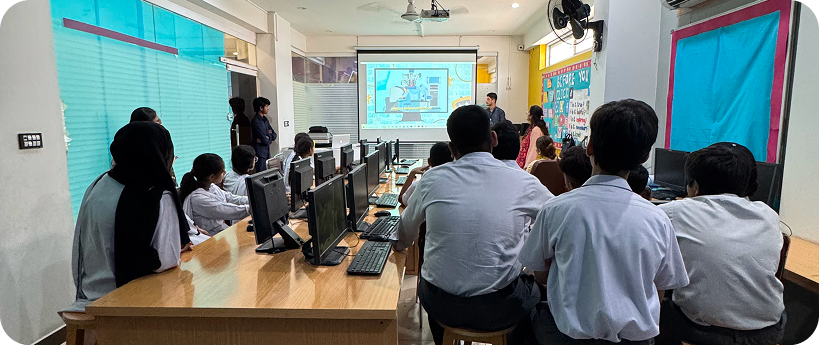
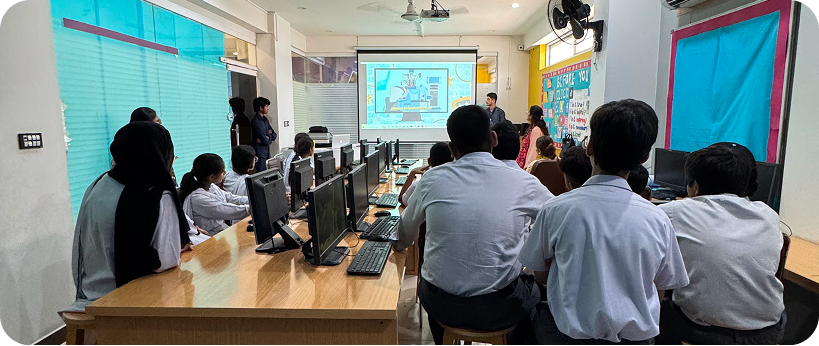
Learning is hands-on. Children try to build, test, ‘fix,’ and retest. This type of learning will stay in the mind. Content is related to one another. A single project could contain any and all of the above. Children begin to understand that knowledge is not separate, but whole.
There is no one correct answer. Children are taught to think in several ways with STEM. The objective is to remember the right answer, but to do it in a different way – thinking is a totally different ballgame.
What is STEAM Education in Practice?
Let us make this clear with some examples you can visualise.
Robotics: A child creates and constructs a little robot. They measure (math), put them together (engineering), write the code to move them (technology), and test them out and see how they respond (science).The project is divided into four subjects all of which are subjects that are learned naturally.
AI Projects: Children explore and experience what AI is, and what it is not, as a tool not a trend. They observe machines taking in information and making decisions. This knowledge is no longer an option in today’s world, where AI has become a part of daily life.
Coding a Game: A child programs the running of a basic game. It requires a bit of logic, sequencing and creativity to get it to be fun. When the game is successful, it can be immediately gratifying as well as tangible.
Design Challenges: Children are challenged to create a solution to a constraint, e.g., “Make the strongest bridge you can, using the materials provided. It’s the simplest engineering thinking and it’s the fun of the children.
Why is this Important for Children in Pakistan?
This is not just a global trend that Pakistan is catching up to. It is a practical reality that is already affecting what jobs exist and what skills employers are looking for.
Work is changing. Tasks that people used to do manually are being automated. There are new job types that are becoming a thing today, which were not there 10 years ago. The children who enter the school gates today will be entering a different and very different world of work from that their parents experienced.
Skills such as logical thinking, problem solving, understanding how technology works, coding, etc., STEM and STEAM, will be developed as a foundation. Not only for tech jobs, but in all industries. A child who is familiar to these concepts will always have more choices, never less.
Pakistan is youthful country with a rapidly expanding tech industry. The demand of people with such skills is already here. The problem is that the disparity lies in early education; that is, the fact that children are not given the proper beginnings, before they reach university or the job market.
What Age Should You Start?
This may be the most frequently asked question by parents, and the truth is, earlier than many people realise, but never too late, either.
Simple Coding Games and Logic Puzzles are available for kids ages 5-8. It’s a game designed for teaching purposes so that the child stays entertained whale learning, and that’s what it should be. The thinking skills that are cultivated during this period are surprisingly persistent.
Children are ready for robotics, learning about basic AI concepts, and more structured project work between the ages of 8 and 12. This is where the magic typically takes place. Something just “clicks,” they begin to understand what they can actually do, and motivation comes on its own.
Once children have reached level 12, they are able to do more advanced projects, enter competitions and begin investigating specific areas of interest. All this is made much easier with a foundation built previously.
How GleeGather is tackling STEM Education
GleeGather is a STEM institute in Pakistan specially created for children. The courses are on robotics and AI, and the entire teaching is hands-on from the beginning.
Children who come to GleeGather are not sitting and listening to lectures. They are creating, programming, experimenting and solving problems. The level of challenge is always at the right level; never too easy to be boring, never too hard to be discouraging because the curriculum is structured for various age groups.
The aim is not simply to complete a course. It is to leave a thought, a skill in thinking, in approaching a problem, staying with the child, and with him after the class.
To Sum It Up
Science, Technology, Engineering, and Mathematics, also known as STEM. STEAM is the addition of Arts to that. Both are a form of learning that enables children to learn in a world rapidly changing beyond the scope of any curriculum.
This is by no means something that can be delayed until secondary school or university for Pakistani parents. The younger children become accustomed to this line of thinking, the more natural it will become. If you wish your child to begin building those skills now, GleeGather’s Robotics and AI courses are a great place to start. The learning is authentic, the environment is stimulating and the ability your child builds will be used outside of the classroom.
Common Questions Parents Ask
1Is STEM only for children who are already good at math or science?
No. STEM is for curious children. Some of the best STEM learners are creative thinkers who were never particularly interested in traditional science class. The approach is different enough that many children surprise themselves.
2What is the difference between STEM and STEAM?
STEM stands for Science, Technology, Engineering, and Mathematics in education. While STEAM stands for Arts, which brings in design thinking and creativity. Both are valuable. STEAM simply recognizes that creative and technical skills belong together.
3Is this relevant for Pakistan specifically?
Very much so. Pakistan’s tech industry is growing, and there is real demand for people with technical skills. Getting children started early puts them in a much stronger position, whether they end up in tech or in any other field that increasingly relies on technology.
4How is STEM education different from what schools already teach?
Most school curriculums still teach subjects separately and focus heavily on memorization and exams. STEM education is project-based, interdisciplinary, and focused on thinking skills rather than recall. The two can complement each other, but STEM fills a gap that traditional schooling often leaves open.